How do the brains of newborns and adults perceive speech sounds?

We are pleased to announce the first study published by Giulia Danielou - a doctoral student at the LPL under the supervision of Clément François - in collaboration with the CRPN and the APHM. It has just been published in the European Journal of Neuroscience as part of the ANRJCJC BABYLANG project led by Clément François:

Reference: Danielou, G., Hervé, E., Dubarry, A.S., Desnous, B., François, C. Event-related brain potentials and Frequency Following Response to syllables in newborns and adults. European Journal of Neuroscience.

Full text article: https://doi.org/10.1111/ejn.70418

Summary:
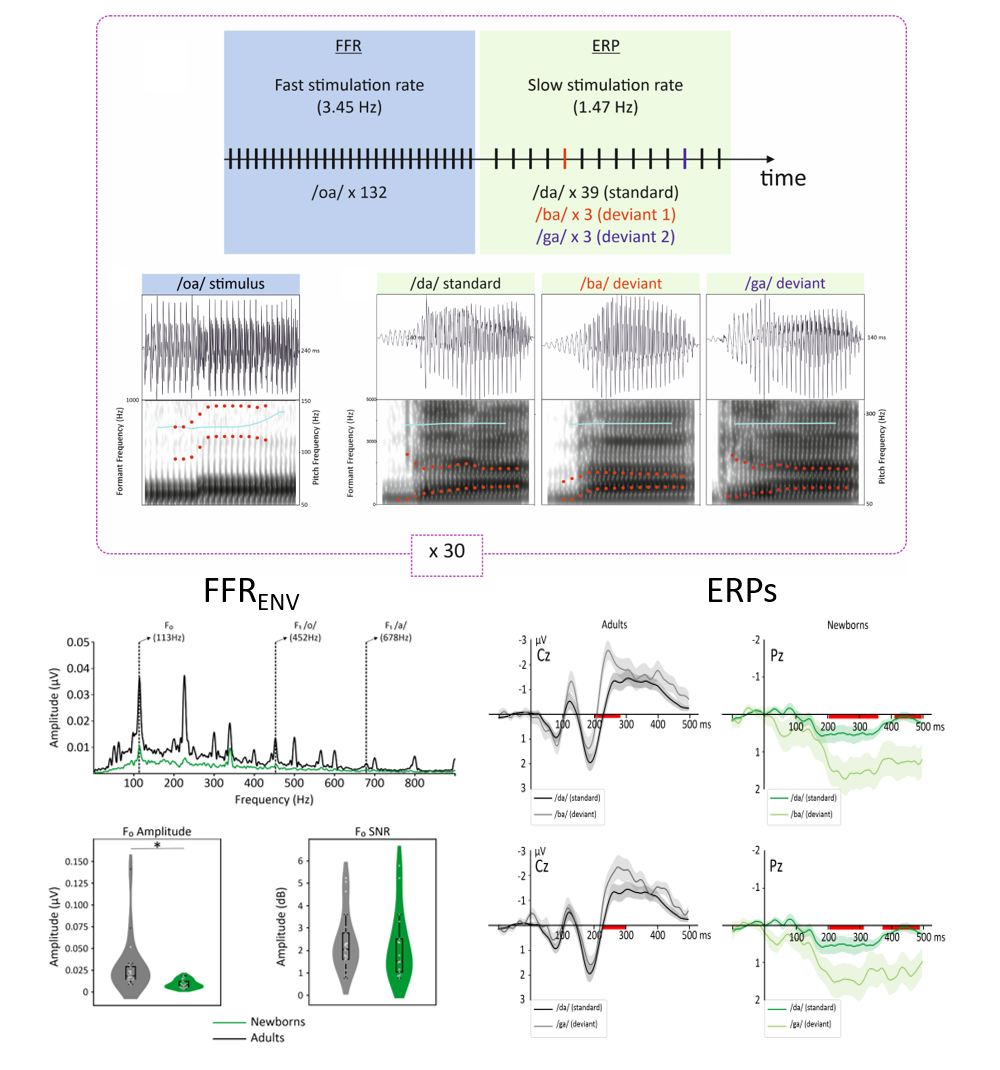
From birth, newborns are able to distinguish speech sounds, an essential skill for learning to speak. But how does their still-immature brain process these sounds compared to that of adults? This study explores the brain mechanisms that enable newborns and adults to perceive syllables such as /ba/, /da/ and /ga/. To do this, they recorded auditory evoked potentials (ERPs) and frequency following responses (FFRs) in 17 three-day-old newborns and 21 young adults. The FFR reflects the encoding of acoustic characteristics of sounds such as fundamental frequency or formants, while ERPs measure the brain's response to category changes in a sequence of repeated syllables. The results confirm that babies are born with brains that are already sensitive to speech sounds, but that their processing is less accurate than in adults. This study confirms the key role that experience and brain maturation play in language acquisition, opening avenues for better understanding the influence of the environment on brain development.


Credits: Authors
The perception of lexical pitch accent in South Kyungsang Korean

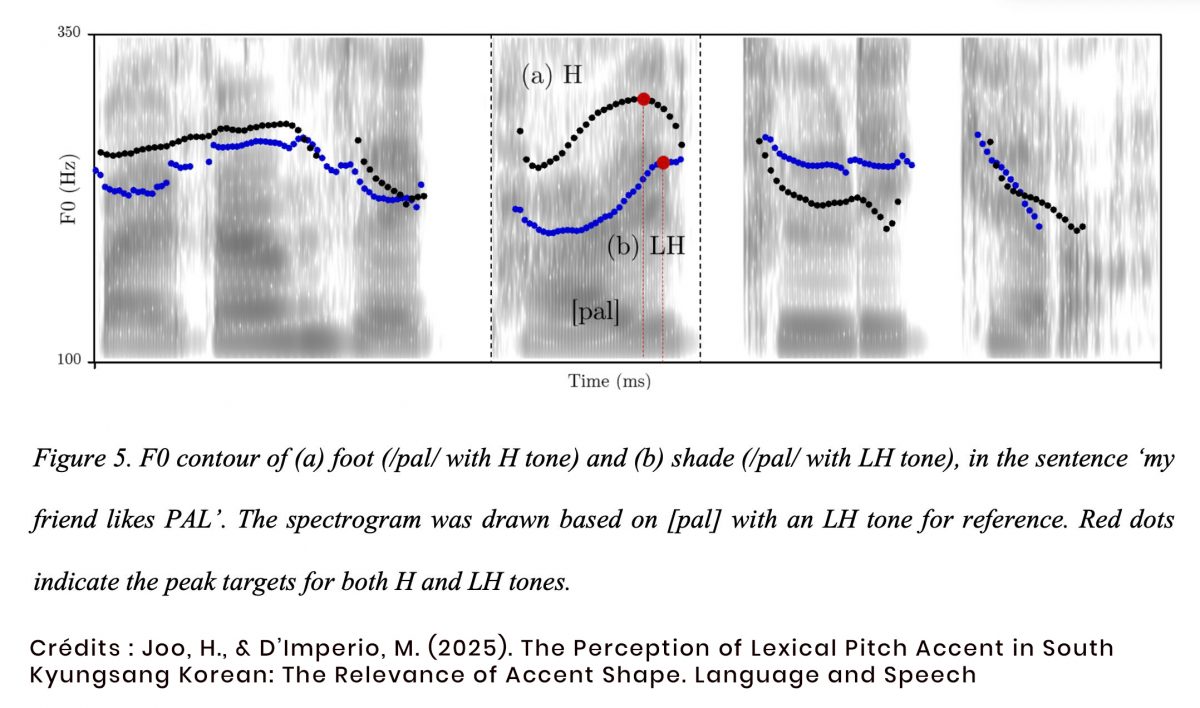
We are pleased to share with you the latest work published by our colleague Mariapaola D'Imperio (LPL-amU) and Hyunjung Joo of Rutgers University in Language and Speech:

Reference: Joo, H., & D’Imperio, M. (2025). The Perception of Lexical Pitch Accent in South Kyungsang Korean: The Relevance of Accent Shape. Language and Speech, 0(0).

Abstract: https://doi.org/10.1177/00238309251368294

Full text access through BibCNRS platform: https://bib.cnrs.fr/ (authentification required)

Why do we perceive the same sounds in the same way?

Noël Nguyen, Leonardo Lancia and Lena Huttner from the LPL, in collaboration with researchers from GIPSA-Lab and LPNC, have just published the first Registered Report in Glossa Psycholinguistics, an online Fair Open Access journal:

Nguyen, N., Lancia, L., Huttner, L., Schwartz, J., & Diard, J. (2024). Listeners' convergence towards an artificial agent in a joint phoneme categorization task.Glossa Psycholinguistics, 3(1). http://dx.doi.org/10.5070/G6011165

Abstract and full text: https://escholarship.org/uc/item/0dg0g4kn


Credits: The authors

SOLIST project: Qingye SHEN joins the LPL

As part of the SOLIST project, we are pleased to announce the arrival of Ms Qingye Shen as a technical collaborator. Qingye Shen will contribute to the implementation of various experiments aimed at studying interactions between listeners in speech perception. Qingye Shen is a Chinese national and holds a bachelor's degree in biological sciences and a master's degree in ecology from East China Normal University in Shanghai. She previously held administrative responsibilities at the Shanghai Key Laboratory of Brain Functional Genomics. SOLIST (The Social Listener) is a research project supported by the Institut Carnot Cognition. It brings together members of the laboratory (Noël Nguyen, Leonardo Lancia, Thierry Legou) and two French partners (Julien Diard, LPNC, Grenoble; Ladislas Nalborczyk, NeuroSpin, Paris-Saclay).

More information: https://www.lpl-aix.fr/actualite/nouvelles-du-carnot-cognition-interview-avec-roxane-bertrand-deux-nouveaux-projets-lpl-finances/

Do you want /ʃoloka/ on a /bistɔk/?

Sophie Dufour, CNRS research director at LPL, has just published two articles with Jonathan Grainger (LPC) and Jonathan Mirault (LPC) on the perception of non-words. The first study seeks to understand whether non-words created by the transposition of two phonemes (/ʃoloka/) are perceived as being more similar compared to their base words (/ʃokola/) [chocolate] than non-words created by substituting two phonemes (/ʃoropa/). Then, in the second article, the authors continue their research by positioning the phonemes differently within the non-word.

  • Sophie Dufour, Jonathan Grainger. When you hear /baksɛt/ do you think /baskɛt/? Evidence for transposed-phoneme effect with multisyllabic words.. Journal of Experimental Psychology: Learning, Memory, and Cognition, American Psychological Association, In press, ⟨1037/xlm0000978⟩. ⟨hal-03141336⟩
  • Sophie Dufour, Jonathan Mirault, Jonathan Grainger. Do you want /ʃoloka/ on a /bistɔk/? On the scope of transposed-phoneme effects with non-adjacent phonemes. Psychonomic Bulletin and Review, Psychonomic Society, 2021, ⟨3758/s13423-021-01926-9⟩. ⟨hal-03225295⟩

A boost for research on child language

In the beautiful series of project funding approved in 2020/2021, we are pleased to present two contracts dedicated to the acquisition and development of language in babies:

Coordinated by Clément François, the research project "BabyLang: Children's speech perception and vocabulary acquisition" was selected by the ANR within the framework of the JCJC 2020 call for projects. This project aims to study hierarchy learnings underlying language acquisition in term babies and premature babies. It will provide a better understanding of (i) the mechanisms of cerebral plasticity underlying the emergence of phonological categories, (ii) the links between early perception of speech and the ability to learn new words, (iv) the impact of 'premature birth on these processes, and (iv) identification of early biomarkers of later language skills.

The research project "LangDev: From speech perception in babies to vocabulary acquisition in children, an interdisciplinary project", coordinated by Laurent Prévot and Clément François, was funded within the framework of the call for projects 80 Prime du CNRS. It aims to determine how the development of the encoding of speech sounds influences the emergence of conceptual and lexical representations in babies. In addition, Estelle Hervé, winner of the doctoral scholarship associated with the project, joined the project team at the end of 2020.

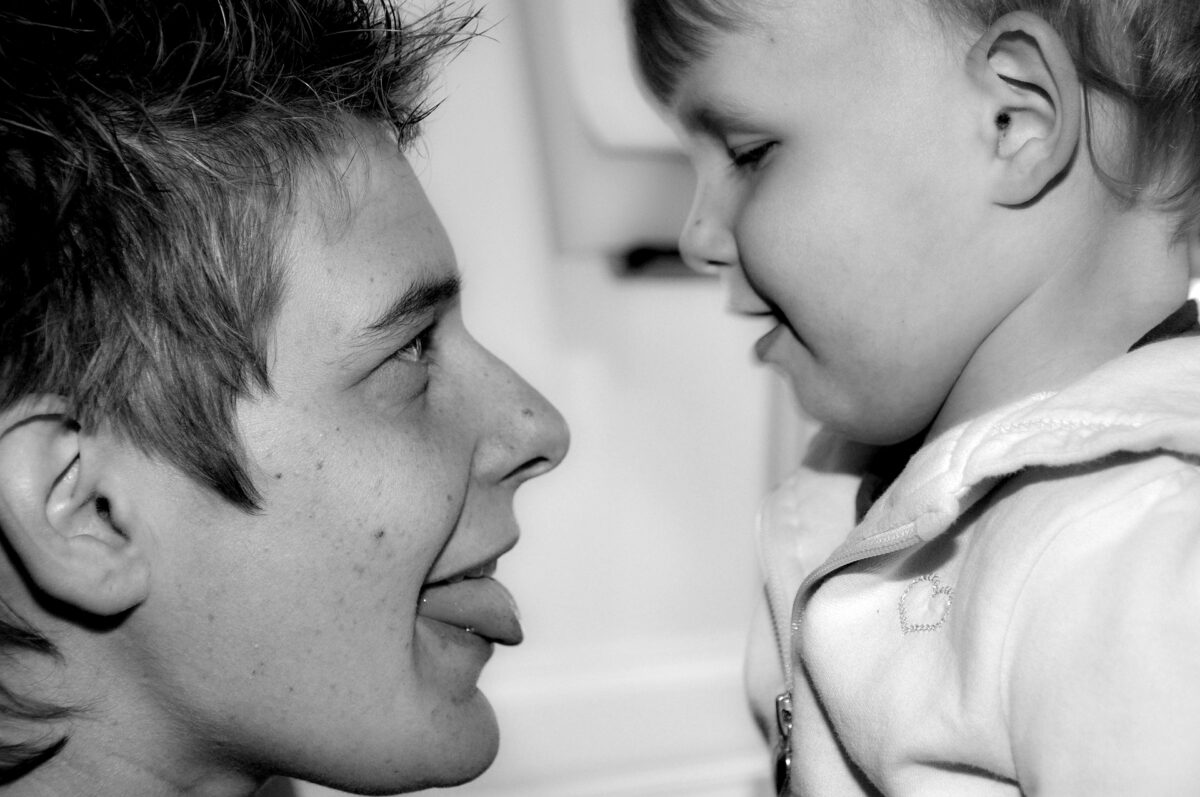
Image by Andi Graf of Pixabay